
Across Canada, recycling systems for packaging and paper products – including food and beverage cartons – continued to evolve in the past twelve months, with provinces at various stages of implementing or refining extended producer responsibility (EPR) curbside collection and deposit return programs. From Ontario’s completion of its historic blue box transition to launches in Alberta, Nova Scotia and the Yukon, it was another year of significant milestones. Here’s our annual overview of where things stand, province by province.
Ontario
- Ontario’s transition to full EPR for paper and packaging, the largest recycling transition undertaken in Canada, was completed on January 1 with the onboarding of the last group of communities.
- January 1 also saw the accepted material list—which includes non-alcoholic food and beverage cartons—applied uniformly across the province and the definitive end of Stewardship Ontario which had operated Ontario’s blue box program for the past 20 years.
- At a recent industry event in Toronto, Circular Materials executives shared that the common collection system now provides recycling services to over 5 million households throughout Ontario, across 383 municipalities and 12 First Nations communities. They also spoke about the objectives for CM’s promotion and education efforts, which include reducing contamination and increasing recycling rates. The average contamination rate in the province’s blue boxes currently stands at 18.8% (single and dual-stream programs combined). To this effect, CM launched an Ontario-wide campaign in January on various platforms, including radio, digital, out-of-home, and print.
- In early February, CM announced that WM had begun operations of two new state-of-the-art materials recovery facilities (MRFs) in Cambridge and the Greater Napanee area with capacity to handle approximately 30% of Ontario’s total blue box contents, as well as to sort cartons separately into their own bales.
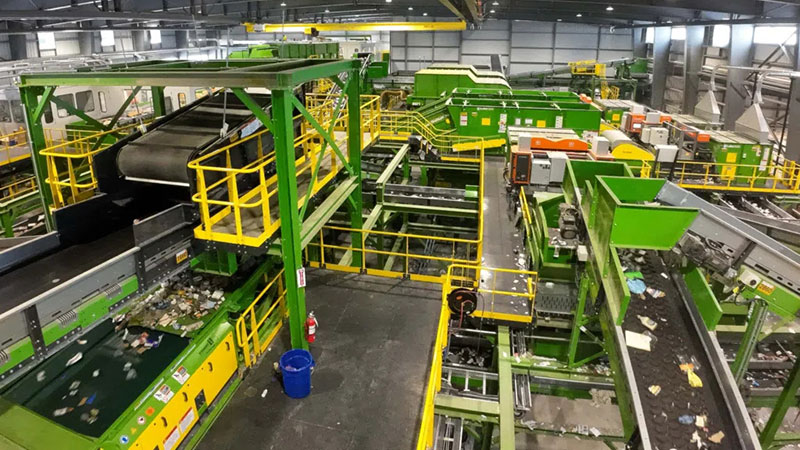
New MRF in Greater Napanee, Ontario. Source: Circular Materials
- On September 3, 2025, the Government of Ontario finalized amendments to its Blue Box Regulation. These include the postponement until 2031 of free collection to schools and other facilities that were not receiving the service from their municipalities prior to transition.
- In December, the government then finalized amendments to the Resource Recovery and Circular Economy Act, which provide the province with new authorities to improve system assessment and data gathering, boost transparency on costs and program data, and maintain collection for small businesses.
- On the deposit return system (DRS) front, The Beer Store reached an agreement in the fall with grocery stores licensed to sell alcohol that sees them join the LCBO in paying into the Ontario Deposit Return Program, for which The Beer Store is the service provider. In exchange, these grocery stores are relieved of their obligation to receive empty alcohol containers (including wine cartons) in-store for refund and may refer customers to the nearest The Beer Store location instead.
Québec
- Éco Entreprises Québec (ÉEQ) recently released its review on the first year of operation of the province’s modernized curbside recycling system under full producer responsibility. Highlights include:
- Reduction of the number of collection contracts, from 562 distinct municipal contracts in 2024 (before the transition began), to 282 temporary agreements in 2025 (during transition), and finally to 125 contracts as of January 1, 2026;
- 21 contracts signed with MRFs and pre-sorting centres;
- Implementation of a new business model for the sale of recycled materials: ÉEQ has gradually been taking on this responsibility, and will be in charge of the sale of all materials by spring of this year;
- 791,000 tonnes of materials collected by the system in 2025, including:
- 26,000 tonnes that are covered by a different EPR collection system (mostly deposit-bearing containers);
- 160,000 tonnes (about 20%) that come from institutions, businesses, and industries (ICI), which is significantly more than in other provinces.
- ÉEQ achieved an 87% collection rate for the residential sector (excluding the ICI tonnes collected). This performance is measured against supplied tonnes as reported by producers, which is a change from how this metric was reported in the past.
- 607,000 tonnes were sent for recycling, with 63% of these sent to recyclers in Québec.
- The overall contamination was measured at 13% (down from 14% in 2024). Reducing the contamination rate will be a priority for ÉEQ in the coming years via provincial P&E campaigns.
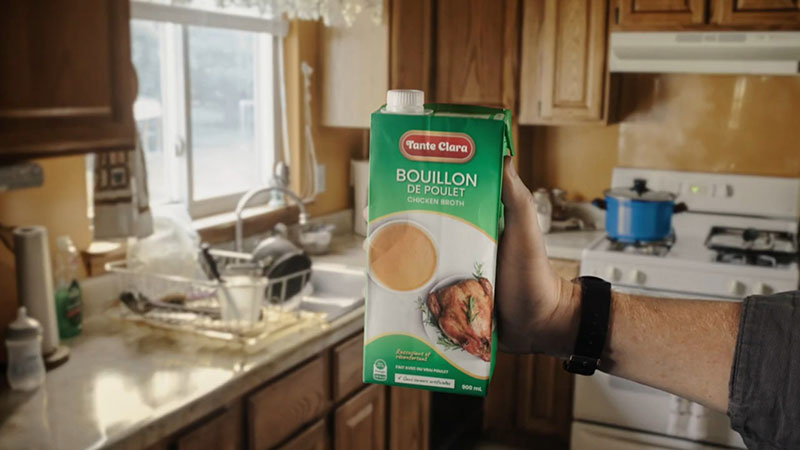
- On the topic of P&E, ÉEQ’s communications in 2025 focused on cementing its simplified sorting rule: “Containers, packaging, printed paper. That’s it.” Of note is the commercial that has been airing on television and online, where a broth carton can be seen for a split second to remind us that it goes in the bin too!

ÉEQ TV commercial. Source: Éco Entreprises Québec
- On March 16, the Québec Ministry of the Environment published an administrative position confirming its intention to postpone the coming into force of new collection services (including for institutions, businesses and industries [ICI]) and to adjust certain performance targets. Among the adjustments is the deferral of 2027 collection rate targets for all materials to 2030. With beverage cartons covered by the DRS starting in 2027, the food cartons that remain under the blue box program have been incorporated in the “paper and cardboard” category.
- On March 19, as part of the province’s budget, $27million in financial assistance was announced by the Québec government to support producers in their transition to the new EPR system. ÉEQ welcomed this announcement and indicated it would distribute the funding to eligible businesses to mitigate the financial impacts associated with the overlap between the old compensation plan and the new EPR system. ÉEQ estimates that the amount will cover about 50% of producers’ obligations for 2025, depending on the final number of eligible producers.
- In October 2025, Consignaction, the designated management body (DMB) set up by the Québec Beverage Container Recovery Association (QBCRA) to operate the province’s modernized deposit return system for beverage containers, released its report on the first 13 months under the new EPR regulation (from November 1, 2023, to December 31, 2024). The organization reported a 68.04% return rate for containers covered during that period as per the regulation, and an overall collection rate of 78.65% when counting all deposit-bearing containers collected in blue boxes.
- Consignaction has continued to deploy its network of return locations, with 121 proprietary return sites in place as of the end of 2025, en route to a target of 400 sites by the time cartons are integrated into the system in March 2027. These are in addition to retail return locations.
British Columbia
- Recycle BC received approval for its Packaging and Paper Product Extended Producer Responsibility Plan from the province’s Ministry of Environment and Parks on September 17, 2025. This new plan brought changes to collection and recycling targets and the methods used to measure them. Cartons continue to be tracked within the broader fibre category.
- In July 2025, Recycle BC launched two RFPs for post-collection services, with the intent of overseeing its post-collection network directly from now on.
Alberta
- On April 1, 2025, Circular Materials launched Phase 1 of Alberta’s EPR program for packaging and paper products covering over 200 communities through either direct management by CM or continued management from municipalities as service providers to CM.
- Phase 2 will launch on October 1, 2026, and will consist in onboarding registered communities without existing services and expansion of services to 121 communities that were previously depot-only.
- Once the transition is complete, CM will introduce a unified accepted material list. For the moment, aseptic and gable top food containers are part of the base list of accepted materials for curbside collection, as laid out in CM’s Community EPR Transition Guide. This list applies to every community receiving curbside collection services since April 1, 2025. Beverage cartons continue to be managed under the province’s DRS.
Saskatchewan
- SK Recycles continues its transition to full EPR for household packaging and paper, which was initiated in December 2024 and is set to be completed in early 2028. SK Recycles has created a province-wide list of accepted materials, which includes food cartons. Communities adopt the list as they join the program.
- SK Recycles and BC Recycle announced the amalgamation of their programs into one legal entity, effective January 1, 2026. The reorganization aims to simplify the organizational structure and create efficiencies and cost savings. Both programs continue to operate as distinct programs under their respective provincial regulations.
New Brunswick
- New Brunswick’s Designated Materials Regulation, the legislation that governs all EPR programs in the province, was updated in July 2024. All PROs were required to comply with the updated regulation by January 1, 2026. Accordingly, both Circular Materials and Encorp Atlantic revised their respective stewardship plans. Encorp Atlantic’s plan was approved in the fall of 2025 and is available on its website. CM’s is available here.
- In May 2025, CM announced it had met a significant milestone: all communities in New Brunswick now have curbside recycling. In 2026, CM continues expanding access to recycling services across New Brunswick, including onboarding additional schools and multi-family dwellings into the EPR program.
- The uniform list of materials will be finalized in 2027. Food and non-deposit beverage cartons are expected to be on this list. The launch of recycling in public spaces is still also targeted for next year.
Nova Scotia
- Nova Scotia’s new Extended Producer Responsibility for Packaging, Paper Products and Packaging-like products Regulations came into force on December 1, 2025, with CM as the approved PRO. CM has maintained the province’s dual-stream blue bag system, while introducing, in July 2025, a province-wide uniform material list, which includes cartons for dairy products and substitutes as well as food cartons. Non-dairy beverage cartons continue to be managed under the province’s deposit return system, operated by Divert NS. It’s worth noting that the transition to EPR in Nova Scotia was not done as a phased roll-out, which is commonly seen in other jurisdictions.
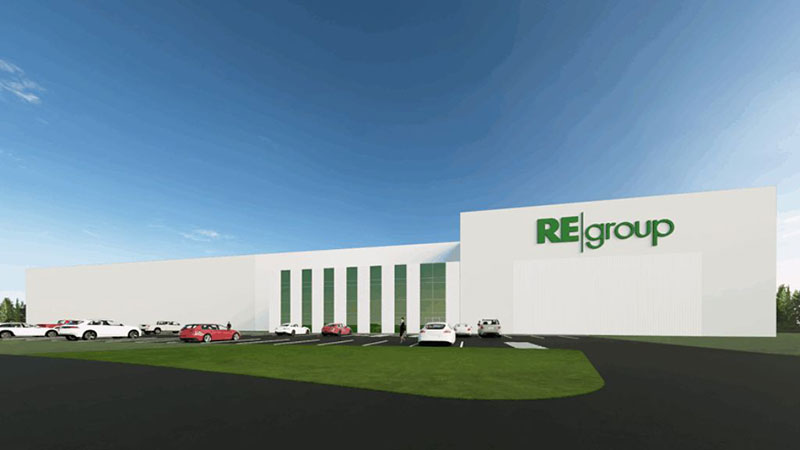
- In late October 2025, Circular Materials announced that REgroup, part of the Municipal Group of Companies, had been selected to design, build and operate a new state-of-the-art preconditioning recycling facility, serving both New Brunswick and Nova Scotia. The Halifax-area facility is planned to be operational in early 2027 and will feature the newest generation of mechanical sorting technologies, including near-infrared (NIR) optical sorters and advanced imaging systems designed and manufactured by CP Group. We’ve also learned it is being designed to sort food and beverage cartons into their own bales.
Upcoming recycling facility in Nova Scotia. Source: Circular Materials
PEI
- Prince Edward Island’s transition of its DRS for beverage containers to an EPR framework occurred on April 1, 2026, with Encorp Atlantic as the designated PRO. Among the changes to the program, the refund model moved from half-back (where half of the amount of the deposit was returned to customers) to full-refund. Beverage cartons, except those for milk and plant-based beverages, are included.
Yukon
- Following approval of its stewardship plan on February 1, 2025, Circular Materials launched the roll-out of Yukon’s EPR program for packaging and paper products on November 1, 2025. Implementation is being phased in, and is scheduled to be completed on May 1, 2027. Circular Materials will introduce a standardized list of materials to make recycling consistent throughout the territory. In the meantime, a list of what can be recycled is featured on CM’s consumer-facing web page. The list includes non-deposit cartons.
Manitoba
- In August, Multi-Material Stewardship Manitoba (MMSM), the designated PRO for the province’s blue box program, revised its updated transition plan to full EPR following consultation with the Ministerial Advisory Committee and the Department of Environment and Climate Change. Approval is still pending. Food and beverage cartons continue to be part of the standardized list of materials collected by the program.
Newfoundland and Labrador, Northwest Territories and Nunavut
- Newfoundland and Labrador held consultations in 2022 on the possible implementation of full EPR for paper and packaging but there have been no public developments recently.
- To date, the Northwest Territories and Nunavut have not proposed the introduction of EPR for paper and packaging.