
The Carton Council Awards Over $75,000 to Support Carton Recycling in Schools Across North America
Falls Church, VA – The Carton Council is proud to announce that its 2025 School Grant Program has awarded a total of $75,634 to19 schools across the U.S. and Canada to help launch, expand or enhance carton recycling initiatives.
The grant program ran from April 1 through May 31, 2025. After a competitive review process, 10 Canadian and 9 U.S. schools were selected for funding. Each grant supports a range of impactful initiatives, from purchasing new sorting bins and signage, to launching student-led green teams and implementing staff training and educational campaigns.
“The strong response to this year’s grant program shows just how motivated schools are to recycle food and beverage cartons,” said Jordan Fengel, executive director of the Carton Council. “We’re proud to provide funding that empowers them to turn that commitment into action, helping launch or expand school carton recycling programs that keep cartons out of landfills.”
The Carton Council grants provide up-front funding to support real-world implementation of carton recycling in K–12 schools. By recycling cartons, schools help ensure these valuable materials are transformed into new paper products or sustainable building materials rather than ending up in landfills.
In addition to funding, the Carton Council provides resources and support for schools, including case studies, templates, and tools to support their recycling efforts.
To learn more about how prior grant recipients have utilized their grant funds, visit the Carton Council’s resources page at: https://recyclecartons.com/resources. Tools and resources to support school recycling are also available on Carton Council of Canada’s web page.
###
ABOUT THE CARTON COUNCIL: The Carton Council is a coalition of four leading food and beverage carton manufacturers—Elopak, Novolex Pactiv Evergreen, SIG, and Tetra Pak— united to deliver long-term solutions to expand the recycling of used food and beverage cartons in the US and Canada. Cartons are commonly used to package products like milk, broth, soup, juice, and other beverages. When recycled, they can be transformed into new paper products or premium building materials, contributing to a circular economy. The Carton Council is committed to working with all stakeholders in the value chain to increase collection, sorting and recycling of used cartons. For more information, visit RecycleCartons.com (U.S.) or RecycleCartons.ca (Canada).
U.S. Media Contact: Jordan Fengel, Executive Director, jordan.fengel@cartoncouncil.org, (940) 220-0585
Canadian Media Contact: Isabelle Faucher, Managing Director, ifaucher@recyclecartons.ca, (647) 967-5881
Carton Council Launches Grant Program to Expand Food and Beverage Carton Recycling in Schools
Organizations Can Receive Up to $5,000 for Recycling Milk and Juice Cartons
Falls Church, VA – April 1, 2025 – Schools across the U.S. and Canada have the opportunity to boost their recycling efforts with financial support from the Carton Council. Grants of up to $5,000 are available to help U.S. and Canadian K-12 schools establish, enhance or expand food and beverage carton recycling programs.
The average school consumes an estimated 75,000 milk, juice and other food and beverage cartons, but only 10% of U.S. primary and secondary schools currently recycle them. In Canada, cartons make up over 9% of elementary school waste sent to landfills, highlighting the need for greater access and participation in school recycling programs. By participating in carton recycling, schools can help ensure these valuable materials are recycled into new paper products or premium building materials.
Applications for the 2025 School Carton grants are accepted from April 1 to May 31st. Eligible applicants include U.S. and Canadian public and private K-12 schools, school districts or boards, school organizations, local governments, or individuals supporting a school’s recycling program. To qualify, schools must confirm they have access to carton recycling by contacting their local waste services provider and receive administrative approval for the initiative before applying.
“By sorting empty milk, juice, and other cartons, schools contribute to ensuring these cartons are recycled into new products while reducing landfill waste,” said Jordan Fengel, executive director of the Carton Council. “Beyond the environmental benefits, schools may also see cost savings on waste hauling fees while providing valuable hands-on learning opportunities in sustainable practices.”
Grant funds can be used to purchase sorting equipment such as collection bins, create communications, print signage, establish a “green team,” or other activities that support school carton recycling. Past recipients have used similar grants to launch new recycling programs or improve existing ones, reduce waste and engage students in educational sustainability efforts.
Schools interested in enhancing their recycling efforts shouldn’t miss this opportunity. Apply by May 31, 2025, for a chance to receive up to $5,000 in funding. Grant recipients will be selected in June 2025, with funds disbursed shortly after. Resources and support are available to help schools implement effective carton recycling programs. Canadian schools can find details at RecycleCartons.ca/project/2025-carton-recycling-grant-program-for-schools.
###
ABOUT THE CARTON COUNCIL: The Carton Council is a coalition of four leading food and beverage carton manufacturers—Elopak, Pactiv Evergreen, SIG, and Tetra Pak— united to deliver long-term solutions to expand the recycling of used food and beverage cartons in the US and Canada. Cartons are commonly used to package products like milk, broth, soup, juice, and other beverages. When recycled, they can be transformed into new paper products or premium building materials, contributing to a circular economy. The Carton Council is committed to working with all stakeholders in the value chain to increase collection, sorting and recycling of used cartons. For more information, visit RecycleCartons.ca.
Canadian Media Contact: Isabelle Faucher, ifaucher@recyclecartons.ca, (647) 967-5881
Fibres from recycled food and beverage cartons produce high-quality moulded pulp packaging, concludes research from Innofibre
Packaging made from cartons has been shown to be stronger than conventional products made from old newspaper
TORONTO, ON and TROIS-RIVIÈRES, QC, June 27, 2024 — A recent research project conducted by Quebec industrial innovation centre Innofibre has demonstrated that used food and beverage cartons, which are mostly made from paperboard, show great potential for the manufacture of moulded pulp packaging. At present, no manufacturer of such packaging in North America uses pulp made wholly or partly from fibres derived from recycled cartons.
Cartons come in two variants: shelf-stable cartons, also known as aseptic cartons, and refrigerated, or gable top, cartons. In addition to paper, cartons are composed of thin polyethylene coatings and, for shelf-stable cartons, an additional fine layer of aluminum. Cartons are commonly used for such products as juice, milk and milk substitutes, soups, water and wine.
Innofibre is an applied research centre renowned for its expertise in the development of products made from plant fibres. For this research, Innofibre produced pulp from post-consumer cartons obtained from a Quebec material recovery facility (MRF), which it then transformed into moulded products using two commonly used techniques: transfer moulding and thermoforming. “Our tests confirmed that recycled carton fibre pulp has similar mechanical and physical properties to virgin kraft pulp,” explains principal researcher Eric Desnoes. “This means that we can manufacture high-quality moulded products with it.” According to the researcher, the strength of carton pulp is therefore significantly higher than that of mechanical pulp, such as that obtained from old newspaper, which is the pulp most frequently used for moulded products made from recycled fibres. In addition, the research concludes that carton pulp would be particularly suitable for industrial manufacturing, given the relatively short production time of items and a shrinkage rate that does not interfere with nesting.
“Packaging made of recycled carton pulp could be used to contain or protect a wide variety of products in the food and non-food industries,” says Isabelle Faucher, Managing Director of Carton Council of Canada, which commissioned the research. The mission of the organization, which brings together four competing companies—Elopak, Pactiv Evergreen, SIG and Tetra Pak—is to work with the various stakeholders to increase the collection and recycling of these containers. The partnership with Innofibre aims to encourage the emergence of new local recyclers for cartons collected in Canada. The Council now hopes to collaborate with pulp and moulded packaging manufacturers in the country who would be willing to further explore the possibilities offered by recycled carton pulp. In particular, the Council would consider participating in the financing of additional in-house R&D and in the acquisition of new equipment.
The full Innofibre research report can be downloaded in English and French.
According to data compiled by Carton Council of Canada, around 34,500 tonnes of post-consumer cartons per year are collected through blue box and deposit-return programs in Canada, a portion of which are still recycled outside North America. As a result of the transformation of programs underway across the country under full extended producer responsibility policies, the Council expects to see an increase in the number of cartons collected and in the local recycling rate over the next few years. “In a context of declining volumes of newsprint and office paper, cartons can represent an alternative source of quality raw material for packaging manufacturers accustomed to working with recycled fibres, as well as for those seeking to increase their participation in the circular economy,” believes the Council’s Managing Director.
Correction: July 8, 2024 — In the sixth paragraph of the original version of this news release, “58,000 tonnes” was inadvertently stated as the quantity of post-consumer cartons collected per year in Canada. The correct figure is 34,500 tonnes. “58,000 tonnes” is actually the quantity of new cartons put on the Canadian market yearly by food and beverage producers. We are sorry for this error.
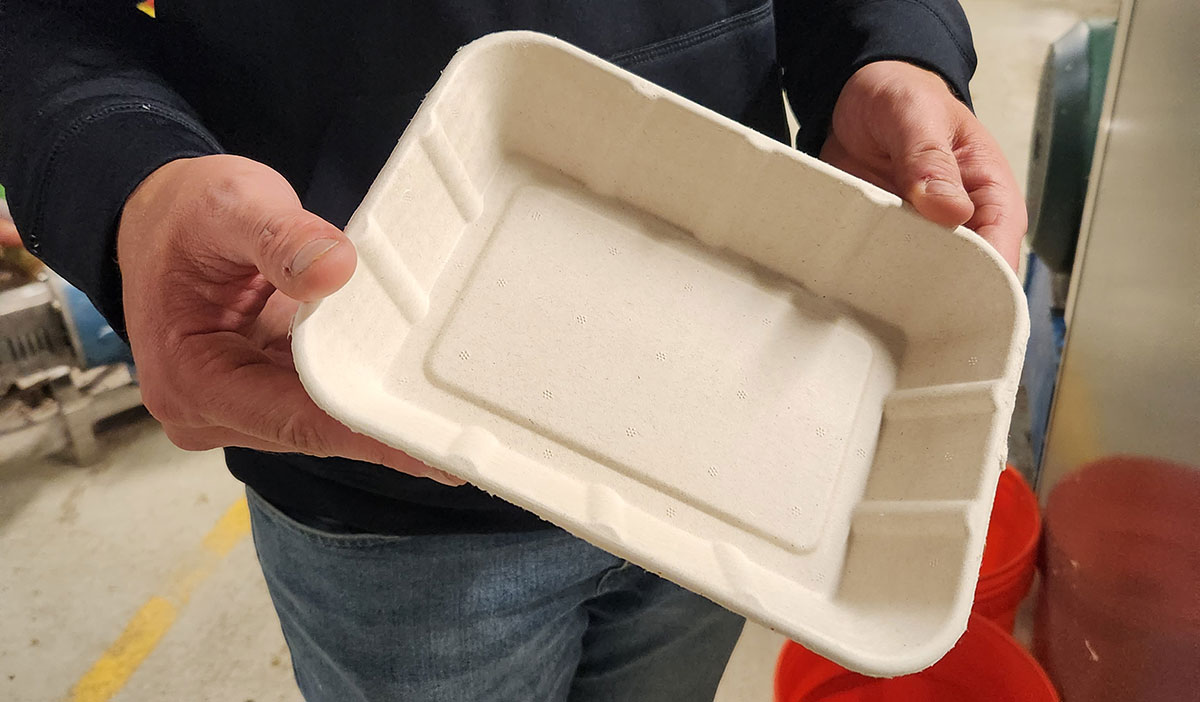
Thermoformed tray made from recycled cartons
Other Images
- Picture of Eric Desnoes
- Picture of Isabelle Faucher
- Innofibre research team (with Isabelle Faucher on the left, next to Eric Desnoes)
- Innofibre logo
- CCC logo
- Examples of cartons
- Thermoformed (left) and transfer moulded (right) packaging made from recycled cartons
- Thermoformed tray made from recycled cartons
About Innofibre—Cellulosic Products Innovation Centre
Innofibre’s vision is to be recognized as a key player in the establishment of Quebec’s bioeconomy. Innofibre supports the innovation and diversification of biomass products and adapts pulp and paper technologies into innovative processes. Innofibre owns specialized analytical laboratories and pilot facilities unique in North America. Our partners can count on a multidisciplinary team to meet their needs and carry out applied research mandates. For more information, visit https://innofibre.ca/en.
About Carton Council of Canada
Carton Council of Canada (CCC) is a coalition of four carton manufacturers: Elopak, Pactiv Evergreen, SIG and Tetra Pak. Formed in 2010, CCC works with all stakeholders in the recycling value chain to increase carton collection and recycling across the country. For more information, visit recyclecartons.ca.
###
Sources: Carton Council of Canada and Innofibre
Media: Eloi Courchesne, eloi@ecourchesne.com, 514-923-3564
Carton Council of Canada Launches 2024 Community Education Award in Alberta, Saskatchewan and Manitoba
Up to 15 organizations in Canada’s Prairie provinces can receive $2K each for recycling education efforts that include cartons
Toronto, Ontario, April 22, 2024 – Today, Carton Council of Canada (CCC) is pleased to announce the launch of the fourth year of the organization’s Community Education Award (CEA) program. Established in 2021, the program was developed to support and enhance recycling education in Canadian communities. In 2024, the Community Education Award program will focus on Canada’s Prairie Provinces including Alberta, Saskatchewan and Manitoba. The CEA program has previously worked with organizations in Ontario, Quebec and Atlantic Canada.
“At Carton Council of Canada, we are immensely proud to launch another year of the Community Education Award Program and to turn our attention to the communities located in some of the western provinces,” said Isabelle Faucher, Managing Director, Carton Council of Canada. “We continue to believe in the tremendous importance of local education to successfully increase general knowledge about recycling, to support the adoption of recycling best practices, and to help improve the rate of carton recycling across the country.”
In the Prairie provinces, the recycling solution for cartons depends on the province and, in some cases, on the product. While all carton types are collected through the residential recycling system in Manitoba, this is not the case in Saskatchewan and Alberta. In those two provinces, cartons containing foodstuffs other than beverages (such as soups and broths) are collected in the residential recycling system while all beverage cartons (including cream) are returned to a recycling depot for refund.
ABOUT ELIGIBILITY
The CEA program is open to organizations based in Alberta, Saskatchewan and Manitoba that educate residents about local recycling programs, particularly those that include food and beverage cartons. This includes cities and municipalities, sorting facilities, deposit return system operators, not-for-profits, and any other organization that has recycling education as part of its mandate.
To receive the award, participating organizations must show that their websites accurately and clearly define carton recycling. They will also be asked to provide at least two other examples of communications activities conducted during the year that promote recycling in general, while also prominently featuring cartons. For more information about eligibility and to register for the program, please visit the CCC website.
ABOUT PARTICIPATION AND AWARDS
The first fifteen organizations to register for the 2024 program will be eligible to receive $2,000 each by demonstrating their proactive recycling education efforts, featuring food and beverage cartons.
Also, for the first time since the launch of the CEA program in Canada, each participating organization’s submission will be automatically considered to receive either a first, second or third place award of merit. Submissions will be evaluated for the awards of merit based on the following criteria: demonstrated communication improvement, utilization of the Carton Council best practices toolkit, community participation in the contest (e.g., number of likes, number of participants in an event, if applicable, etc.), and number of activities.
Based on this evaluation, the first-place winner will receive an additional $3,000. The second-place winner will receive an additional $2,000 and the third-place winner will receive an additional $ 1,000.
Additional information can be found in the terms and conditions of the CEA program.
KEY DATES
- April 22, 2024: Registration for the Community Education Award program opens
- June 21, 2024: Registration for the Community Education Award program closes
- November 1, 2024: Deadline for participating organizations to submit their entry
ABOUT FOOD AND BEVERAGE CARTONS
Food and beverage cartons are highly recyclable materials that come in two kinds: refrigerated cartons that hold products such as milk, fresh juice and egg substitutes; and shelf-stable cartons that hold products like broths, milks, juices, soups and wine, among others. When sorted by themselves at materials recovery facilities (MRFs), cartons are a valuable material in high demand. Made mostly from paper, a renewable resource, cartons have become popular containers for food and beverage products as they are lightweight and compact, with a low carbon footprint. When recycled, they are used to make office and writing paper, tissues, paper towels, food packaging and even sustainable building and construction materials.
ABOUT THE CARTON COUNCIL OF CANADA
The Carton Council of Canada (CCC) is composed of four leading carton manufacturers, Elopak, Pactiv Evergreen, SIG, and Tetra Pak. Formed in 2010, CCC works to deliver long-term collaborative solutions in order to divert valuable cartons from disposal. Carton Council of Canada provides a platform for carton manufacturers in Canada to benchmark and profile cartons as renewable, recyclable and low-carbon packaging solutions.
For the past 14 years, CCC has been working with all stakeholders in the recycling supply chain to increase carton collection and recycling. There is demand for feedstock from food and beverage cartons to make new products, including paper products and building materials.
For more information, visit recyclecartons.ca
Carton Council of Canada Launches 2023 Community Education Award in Atlantic Canada
Up to 15 organizations in Atlantic Canada can receive $2K each for recycling education efforts that include cartons
Toronto, Ontario, April 21, 2023 – Carton Council of Canada (CCC) today announced the launch of the third year of the organization’s Community Education Award program developed to support and enhance recycling education in Canadian communities. In 2023, the Community Education Award program will focus on the provinces in Atlantic Canada including New Brunswick, Nova Scotia, Prince Edward Island, and Newfoundland and Labrador.
The award program is open to organizations based in Canada’s Atlantic provinces that educate residents about local recycling programs, particularly those that include food and beverage cartons. This includes municipalities, sorting centres (both municipal and privately-owned), Regional Service Commissions, not-for-profit organizations, crown agencies, governmental departments, and any other organization that has recycling education as part of its mandate.
To receive the award, participating communities and organizations must show that their websites accurately and clearly define carton recycling. They will also be asked to provide at least two other examples of communications activities conducted during the year that promote recycling in general, while also prominently including cartons. More information about how communities can participate is found here.
The first fifteen organizations to sign up for the program will be eligible to receive $2,000 each by demonstrating their proactive recycling education efforts, featuring food and beverage cartons. Registration opens on April 21, 2023 and will close on June 19, 2023. The participating communities will then have until Friday, November 3, 2023 to showcase their efforts and submit their work to CCC. Content may be created in either French or English and final submissions will be accepted in both languages.
“We are very pleased to launch this initiative for a third year and to extend its reach into Atlantic Canada,” said Isabelle Faucher, Managing Director, Carton Council of Canada. In Atlantic Canada, the recycling solution for cartons depends on the product. Milk, milk substitutes, and cartons containing foodstuffs other than beverages (such as soups and broths) are collected in the residential recycling system while juice and other designated beverage cartons are returned to a redemption centre or recycling depot for refund. “Given the unique recycling approach in Atlantic Canada, it’s all the more important to communicate clearly and effectively to consumers about how to recycle their cartons,” said Faucher.
“At Carton Council Canada, we believe that creative collaborations like our Community Education Award, have a positive impact on local awareness of recycling in general and cartons specifically. We look forward to the efforts of each participating group and their success helping educate the general public about recycling best practices and services,” she added.
In 2021, CCC launched the program to communities across Ontario and, in 2022, CCC ran the initiative in the province of Quebec. “Our participation in the program helped us clarify many questions about the recycling of cartons with our citizens,” says Jacob Bouchard of Société VIA, one of last year’s participating organizations. “We then used the grant money to offer sweaters to the employees of our five plants, which made a lot of people happy!”
ABOUT FOOD AND BEVERAGE CARTONS
Food and beverage cartons are highly recyclable materials that come in two kinds: refrigerated cartons that store, milk, juice and egg substitutes; and shelf-stable cartons that are packaged for broths, milks, juices, soups and even wine. When sorted by themselves at materials recovery facilities (MRFs) or returned to a redemption centre, cartons are a valuable material in high demand. Made mostly from paper, a renewable resource, cartons have become popular containers for food and beverage products as they are lightweight and compact, with a low carbon footprint. When recycled, they are used to make office and writing paper, tissues, paper towels, and even sustainable building and construction materials.
ABOUT THE CARTON COUNCIL OF CANADA
The Carton Council of Canada (CCC) is composed of four leading carton manufacturers, Elopak, Pactiv Evergreen, SIG Combibloc, and Tetra Pak. Formed in 2010, CCC works to deliver long-term collaborative solutions in order to divert valuable cartons from disposal. Carton Council of Canada provides a platform for carton manufacturers in Canada to benchmark and profile cartons as renewable, recyclable and low-carbon packaging solutions.
For the past 13 years, CCC has been working with all stakeholders in the recycling supply chain to increase carton recovery and recycling. There is demand for feedstock from food and beverage cartons to make new products, including paper products and building materials.
For more information, visit recyclecartons.ca.
Carton Council of Canada announces Municipality of Dysart et al as first recipient of 2022 Request for Expressions of Interest (REOI) funding to support carton recycling in Ontario
Toronto, Ontario, September 1, 2022 – Carton Council of Canada (CCC) today announced the Municipality of Dysart et al is the first recipient to receive funding through CCC’s recent Request for Expressions of Interest (REOI). The REOI is focused on soliciting project ideas to help optimize the collection, sorting and recovery of cartons in Ontario.
The original REOI was launched in May 2002 and today CCC announced a second phase of the REOI, extending the deadline for municipalities and waste management companies operating material recovery facilities (MRFs) in Ontario, and other entities responsible for operating residential recycling programs, to respond with their ideas related to improving the rate of carton recovery in the province to 6 pm ET, November 1, 2022.
ABOUT THE Municipality of Dysart et al PROJECT
After review by the CCC, the Municipality of Dysart et al has successfully secured support for a comprehensive public awareness campaign. The goal of the project is to increase the capture of cartons in Dysart’s containers recycling stream by 100% from the current (2022) 44% capture rate to 88% capture in 2023.
The Dysart team will leverage print, online and social media, along with the distribution of reusable recycling bags, to reach more than 7,200 households and deliver local, recycling-focused information. A Waste Composition Study will help evaluate the success of the program.
“The Municipality of Dysart et al is pleased and proud to collaborate with the Carton Council of Canada on building awareness about recycling and carton recovery,” says John Watson, Environmental Manager, Municipality of Dysart et al. “Programs like this are a win for both our community and the environment. The more we all know about the process and impact of recycling, the more effective our local programs can be.”
“We are excited to support a program with the potential to have significant positive impact on carton recovery in the Dysart region,” says Isabelle Faucher, Managing Director, Carton Council of Canada. “Creativity and collaboration are important elements of the REOI program. We look forward to the success of the Dysart team’s efforts.”
ABOUT THE REOI
CCC has set aside an aggregate amount of $70,000 to support projects brought forward through this REOI in 2022. Once approved, projects must be completed within a maximum of two years from the REOI’s launch (i.e., no later than May 4, 2024).
Expressions of interest pertaining to the following areas of focus will be considered:
- Consulting services to enable or to optimize, carton sorting processes. This includes any or all of MRF configuration, sorter placement, technology and storage.
- Financing for audits (e.g., inbound material, container stream, paper stream, bales, etc.), pilot projects and equipment. Example of the later include investments in automation (optical sorters, robots), extensions to existing conveyors and the splitting of bunkers to allocate room for sorted cartons.
- Awareness campaigns to increase the quantity of cartons in the stream.
- Any other focus area that would benefit carton recovery.
It is important to note that cartons do not have to be the sole focus of the project and can be part of a broader initiative.
Full details related to eligibility and the REOI application process
ABOUT THE CARTON COUNCIL OF CANADA
The Carton Council of Canada (CCC) is composed of four leading carton manufacturers – Elopak, Pactiv Evergreen, SIG Combibloc, and Tetra Pak. Formed in 2010, CCC works to deliver long-term collaborative solutions in order to divert valuable cartons from disposal. Carton Council of Canada provides a platform for carton manufacturers in Canada to benchmark and profile cartons as renewable, recyclable and low-carbon packaging solutions.
For the past 12 years, CCC has been working with all stakeholders in the recycling supply chain to increase carton collection and recovery. There is demand for feedstock from food and beverage cartons to make new products, including paper products and building materials.
For more information, visit recyclecartons.ca.
ABOUT THE MUNICIPALITY OF DYSART ET AL
The Municipality of Dysart et al is located in the heart of the Haliburton Highlands in Ontario.
Dysart provides waste management programs to approximately 7,128 residents in 7,298 households (6,966 single-family, 332 multi-family units); 3,957 of which are considered seasonal households.
Dysart manages five staffed waste disposal sites where residents drop off household waste. At no cost, residents can drop-off up to three bags of garbage in clear bags, and unlimited recycling sorted into containers and papers (two-stream recycling). There is no curbside collection in Dysart.
In Dysart, cartons are accepted in its containers recycling stream.
FOR MORE INFORMATION
Please direct questions to Isabelle Faucher at ifaucher@recyclecartons.ca or by phone at (647) 967-5881.